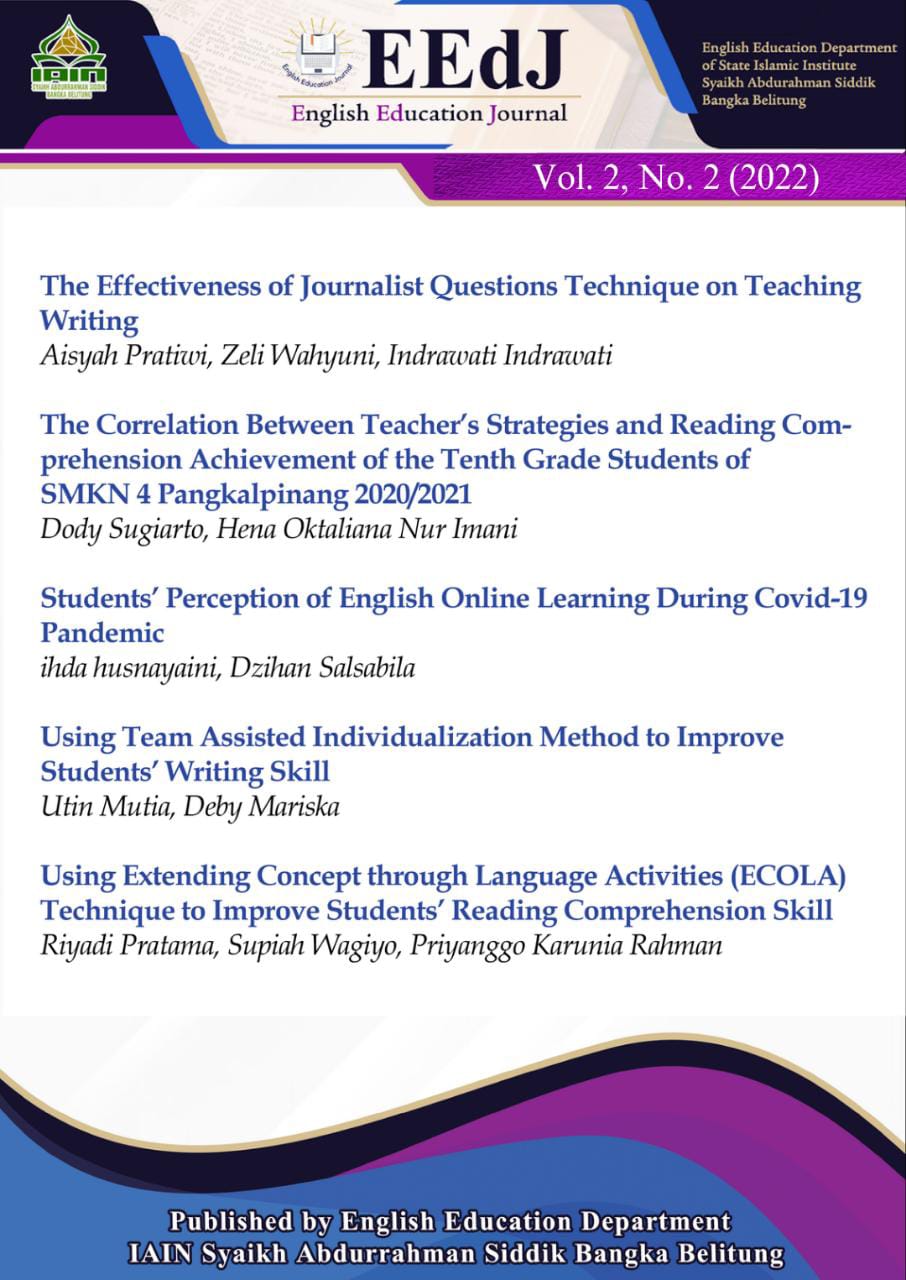
The Correlation Between Teacher’s Strategies and Reading Comprehension Achievement of the Tenth Grade Students of SMKN 4 Pangkalpinang 2020/2021
DOI:
https://doi.org/10.32923/eedj.v2i2.2748Keywords:
Teacher's Strategies, Students, Reading AchievementAbstract
The objective of this study was to find out the teacher’s strategies, the personality differences between male and female students, the students’ reading achievement, and the correlation between students' personality and their achievement in reading at the tenth grade students of SMKN 4 Pangkalpinang. Furthermore, the limitation of this study were 1) the purpose of reading focused on reading to search for simple information, reading to learn from texts, and reading for general comprehension, 2) type of reading was intensive reading, extensive reading. The research method used was quantitative with a correlational design. The population of this study was 2 classes consisting of 33 students at the tenth grade of SMKN 4 Pangkalpin ang. The data were analyzed by using Pearson Product-Moment Correlation. The result showed that the ????????????(0.945) was higher compared to ???????????????????????? at significant level 5% (0.344). Thus, the alternative hypothesis (????????) was accepted and null hypothesis (????????) was rejected. Furthermore, there was a significant correlation between teacher’s strategies and their achievement in reading. In conclusion, teacher’s strategies influenced their achievement in reading.
Downloads
Published
Issue
Section
License
Copyright Notice
EEdJ: English Education Journal is under the Creative Commons Attribution 4.0 International (CC-BY 4.0) License, according to which:
1) Authors retain copyright and grant the journal the right to first publication, with the work simultaneously licensed under the Creative Commons Attribution (CC-BY 4.0) that allows the sharing of articles published with the acknowledgment of authorship and the initial publication in this journal.
2) The authors are authorized to make additional contracts separately for distribution of the version of the work published in this journal (for example, publication in an institutional repository or as a chapter of the book), as long as there is recognition of authorship and initial publication in this journal.
3) Authors are authorized and encouraged to publish and distribute their work online (for example, in institutional repositories or on their personal pages) at any time before or during the editorial process, as it increases the impact and reference of the published work.