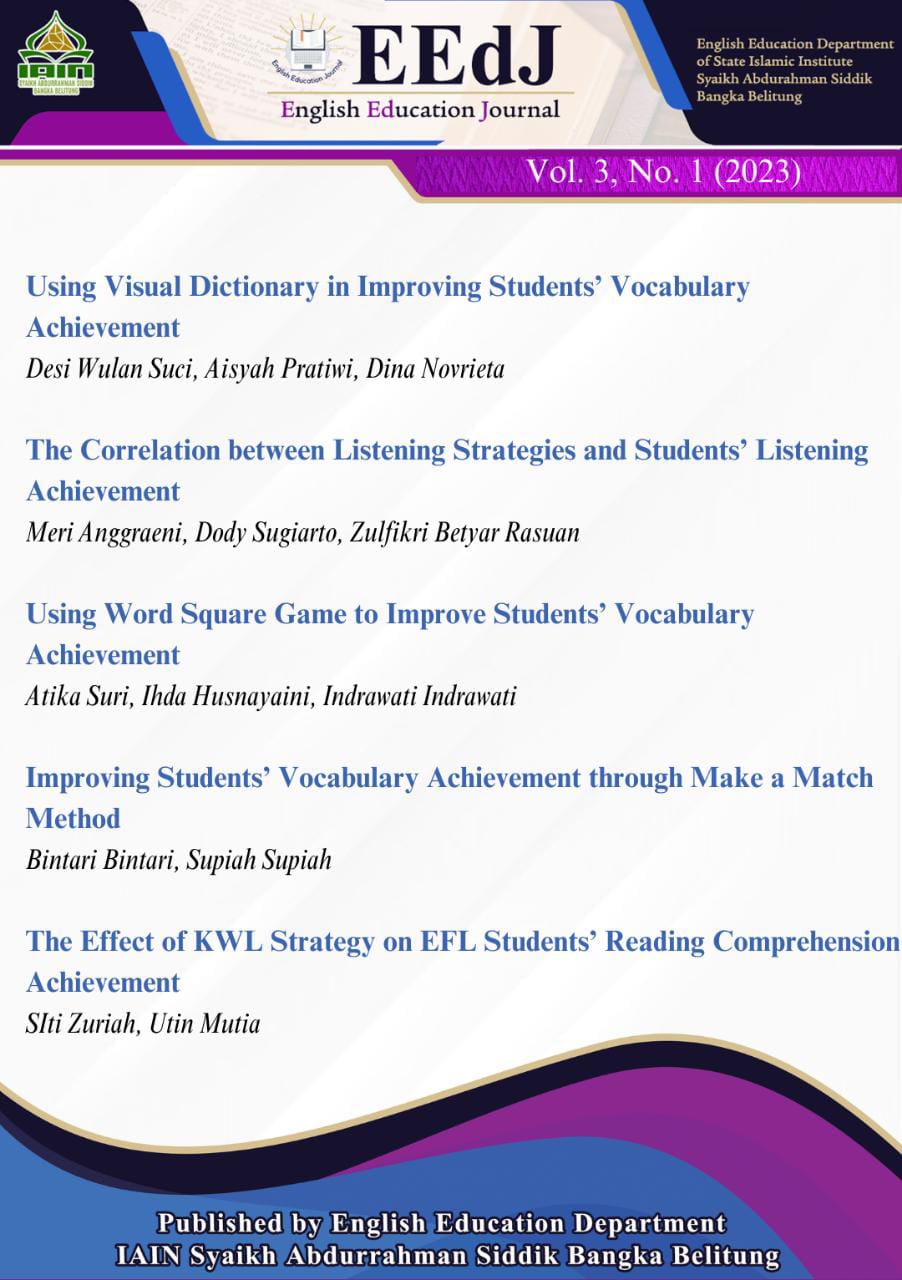
The Effect of KWL Strategy on EFL Students’ Reading Comprehension Achievement
DOI:
https://doi.org/10.32923/eedj.v3i1.3455Keywords:
Reading Comprehension, KWL Strategy, Descriptive TextAbstract
This study sought to ascertain whether implementing KWL (Know, Want, Learned) has a significant effect on EFL students' success with reading comprehension of a public junior high school in Pangkalpinang, Bangka Belitung province. This research employed experimental research with quasi-experimental design. The sample of this study was the eight-graders. The sample consisted of 80 students’ which belongs to two classes; 42 experimental class and 38 students’ in control class. The test was analyzed by using t-test analysis of SPSS 22 (Statistical Package for the Social Sciences). The result of study showed it was effective to use KWL strategy by obtaining this result: the experimental class mean score was 79.45, which means it was higher than the control class’ (mean=79.37). In conclusion, KWL strategy use significantly influences how well students understand what they read.
Downloads
Published
Issue
Section
License
Copyright Notice
EEdJ: English Education Journal is under the Creative Commons Attribution 4.0 International (CC-BY 4.0) License, according to which:
1) Authors retain copyright and grant the journal the right to first publication, with the work simultaneously licensed under the Creative Commons Attribution (CC-BY 4.0) that allows the sharing of articles published with the acknowledgment of authorship and the initial publication in this journal.
2) The authors are authorized to make additional contracts separately for distribution of the version of the work published in this journal (for example, publication in an institutional repository or as a chapter of the book), as long as there is recognition of authorship and initial publication in this journal.
3) Authors are authorized and encouraged to publish and distribute their work online (for example, in institutional repositories or on their personal pages) at any time before or during the editorial process, as it increases the impact and reference of the published work.