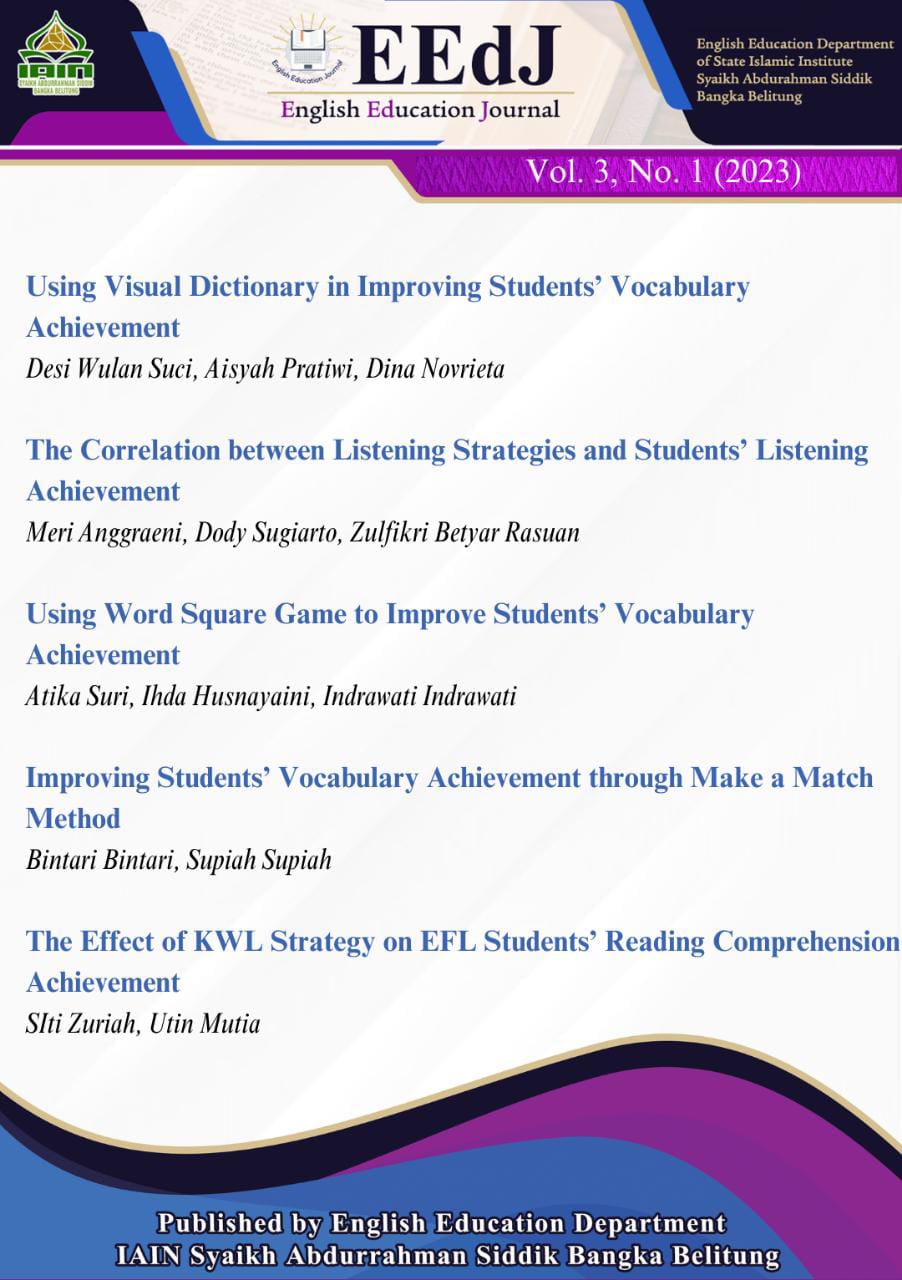
Using Word Square Game to Improve Students’ Vocabulary Achievement
DOI:
https://doi.org/10.32923/eedj.v3i1.3453Abstract
The purpose of this study was to determine the impact of using the Word Square approach on students' vocabulary achievement. Students in the eighth grade from a public junior high school in Mendo Barat, Bangka Belitung, were chosen as the sample for an experimental type of research and separated into two groups using a quasi-experimental design: the experimental group and the control group. The test was the instrument employed in this study, and the t-test analysis was performed to assess the test data. The test result was analyzed statistically using the Paired Sample T-Test and the Independent Sample T-Test. It revealed that the experimental and control groups' respective mean pre- and post-test differences were 34.268 and 33.334. Additionally, the t-obtained post-test value of 1.549 was greater than the essential t-table value of 2.01. The findings suggested that the null hypothesis was disproved and the alternate hypothesis was found. According to the findings, the Word Square was one of the most successful strategies for increasing students' passion for studying English.
Downloads
Published
Issue
Section
License
Copyright Notice
EEdJ: English Education Journal is under the Creative Commons Attribution 4.0 International (CC-BY 4.0) License, according to which:
1) Authors retain copyright and grant the journal the right to first publication, with the work simultaneously licensed under the Creative Commons Attribution (CC-BY 4.0) that allows the sharing of articles published with the acknowledgment of authorship and the initial publication in this journal.
2) The authors are authorized to make additional contracts separately for distribution of the version of the work published in this journal (for example, publication in an institutional repository or as a chapter of the book), as long as there is recognition of authorship and initial publication in this journal.
3) Authors are authorized and encouraged to publish and distribute their work online (for example, in institutional repositories or on their personal pages) at any time before or during the editorial process, as it increases the impact and reference of the published work.