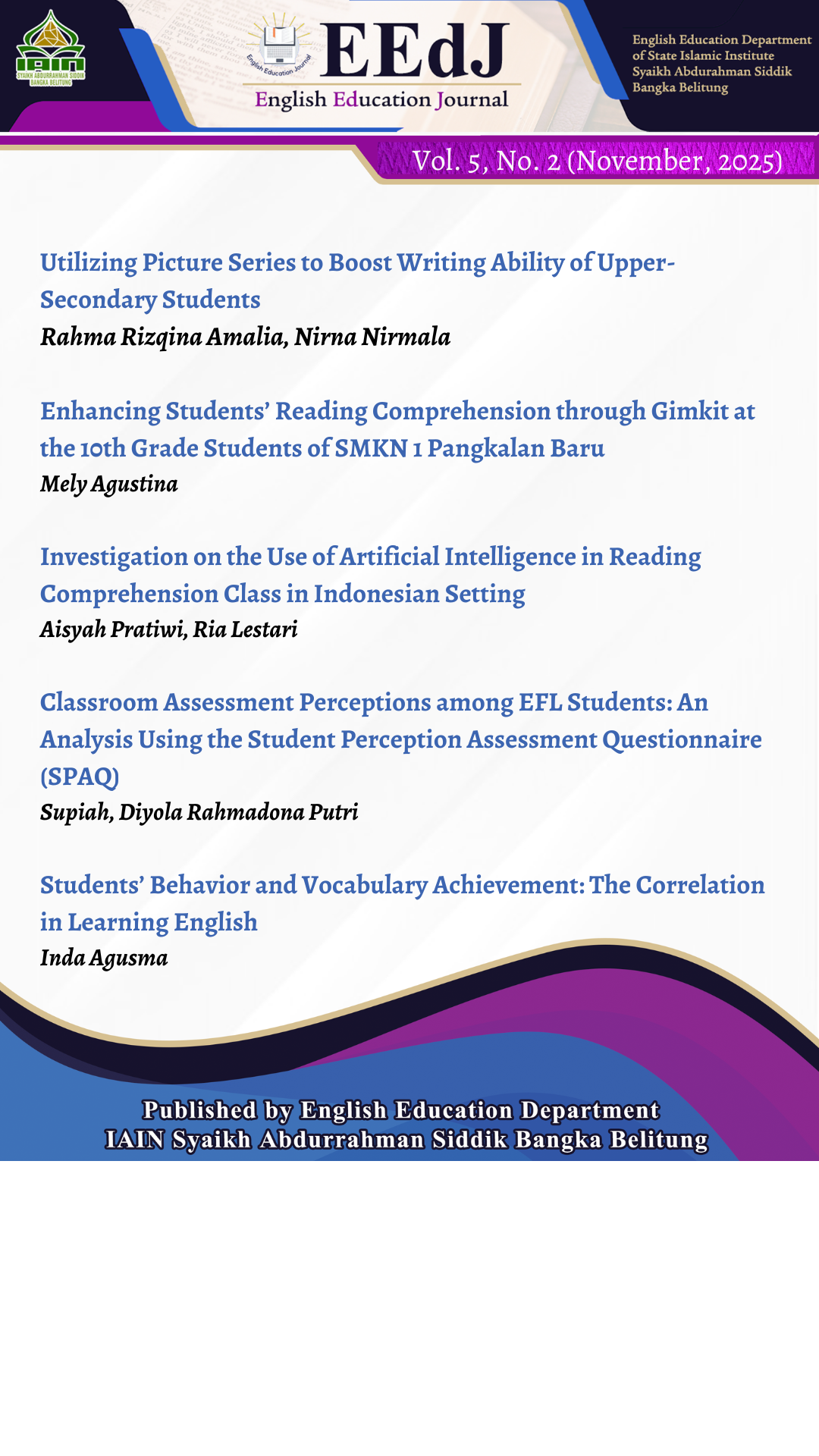
Classroom Assessment Perceptions among EFL Students: An Analysis Using the Student Perception Assessment Questionnaire (SPAQ)
DOI:
https://doi.org/10.32923/mbx76361Keywords:
Students' Perception, Lecturers' Assessment, SPAQAbstract
This study explored students' perceptions of classroom assessment using the Student Perception Assessment Questionnaire (SPAQ) among English Language Education Department (TBI) students at IAIN Syaikh Abdurrahman Siddik Bangka Belitung. The research aimed to examine differences in perception across semesters II, IV, VI, and VIII, and to identify assessment methods used by lecturers. Data collected through questionnaires were analyzed quantitatively, with SPAQ showing high reliability (Cronbach alpha = 0.908). Results showed that students' perceptions were generally high, with the highest mean found among sixth-semester students, suggesting that maturity and study duration influence perceptions. The Authenticity dimension received the highest score, indicating that students view assessments as relevant to real-life contexts. Lecturers primarily employed authentic assessments, including performance, portfolio, and self-assessment methods. Statistical analysis (ANOVA) revealed no significant differences in perception scores across semesters, F (3, 38.724) = 0.159, p = .923. It is recommended that future research incorporate psychological factors, learning maturity, environmental influences, and academic achievement to further understand student perceptions of classroom assessment.
References
Barksdale-Ladd, M. A., & Thomas, K. F. (2000). What’s at stake in high-stakes testing: Teachers and parents speak out. Journal of Teacher Education, 51(5), 384–397.
Black, P., & Wiliam, D. (1998). Assessment and classroom learning. Assessment in Education: Principles, Policy & Practice, 5(1), 7–74. https://doi.org/10.1080/0969595980050102
Haryati. (2009). Model & teknik penilaian pada tingkat satuan pendidikan. Jakarta: Gaung Persada Press.
Kusaeri, & Suprananto. (2012). Pengukuran dan penilaian pendidikan. Yogyakarta: Graha Ilmu.
Mardapi, D. (2008). Teknik penyusunan instrumen. Yogyakarta: Mitra Cendekia Press.
Purwanto, M. N. (2010). Prinsip-prinsip dan teknik evaluasi pengajaran. Bandung: Remaja Rosdakarya.
Sudjana, R. (1989). Penelitian dan penilaian pendidikan. Bandung: Sinar Baru.
Zaenal Arifin. (2009). Evaluasi pembelajaran. Bandung: Remaja Rosdakarya.
Downloads
Published
Issue
Section
License
Copyright (c) 2025 Supiah Wagiyo, Diyola Rahmadona Putri (Author)

This work is licensed under a Creative Commons Attribution 4.0 International License.
Copyright Notice
EEdJ: English Education Journal is under the Creative Commons Attribution 4.0 International (CC-BY 4.0) License, according to which:
1) Authors retain copyright and grant the journal the right to first publication, with the work simultaneously licensed under the Creative Commons Attribution (CC-BY 4.0) that allows the sharing of articles published with the acknowledgment of authorship and the initial publication in this journal.
2) The authors are authorized to make additional contracts separately for distribution of the version of the work published in this journal (for example, publication in an institutional repository or as a chapter of the book), as long as there is recognition of authorship and initial publication in this journal.
3) Authors are authorized and encouraged to publish and distribute their work online (for example, in institutional repositories or on their personal pages) at any time before or during the editorial process, as it increases the impact and reference of the published work.