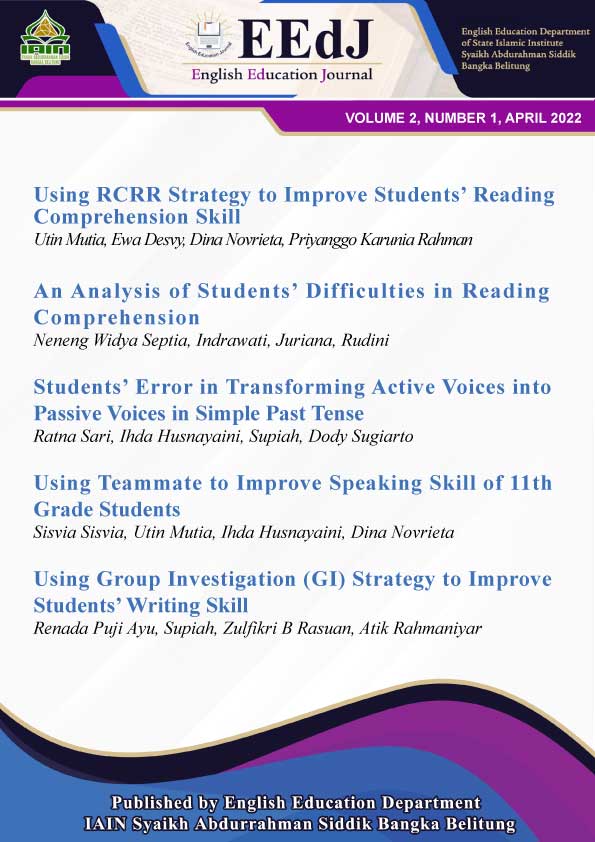
Using Group Investigation (GI) Strategy to Improve Students’ Writing Skill
DOI:
https://doi.org/10.32923/eedj.v2i1.2523Keywords:
Group Investigation, Strategy, Writing SkillAbstract
The aim of this research is to find out the effectiveness of Group Investigation Strategy in improving students’ writing skill This study is experimental and was conducted in Bangka, Bangka Belitung province. 50 students from two classes of middle school were taken as the sample. By using Paired Sample t-test and Independent Sample t-test, the result showed that the students who were taught by using Group Investigation Strategy got higher score than those who were not. The result of independent sample t-test stated that t-obtained (0.420) was lower than critical value of t- table (2.01) and the significant (2-tailed) was 0.670, higher than computation with significant level 0.005. In other words, there was a no significant difference between students who were taught by using Group Investigation Strategy and the students who were taught without using Group Investigation Strategy.
Downloads
Published
Issue
Section
License
Copyright Notice
EEdJ: English Education Journal is under the Creative Commons Attribution 4.0 International (CC-BY 4.0) License, according to which:
1) Authors retain copyright and grant the journal the right to first publication, with the work simultaneously licensed under the Creative Commons Attribution (CC-BY 4.0) that allows the sharing of articles published with the acknowledgment of authorship and the initial publication in this journal.
2) The authors are authorized to make additional contracts separately for distribution of the version of the work published in this journal (for example, publication in an institutional repository or as a chapter of the book), as long as there is recognition of authorship and initial publication in this journal.
3) Authors are authorized and encouraged to publish and distribute their work online (for example, in institutional repositories or on their personal pages) at any time before or during the editorial process, as it increases the impact and reference of the published work.