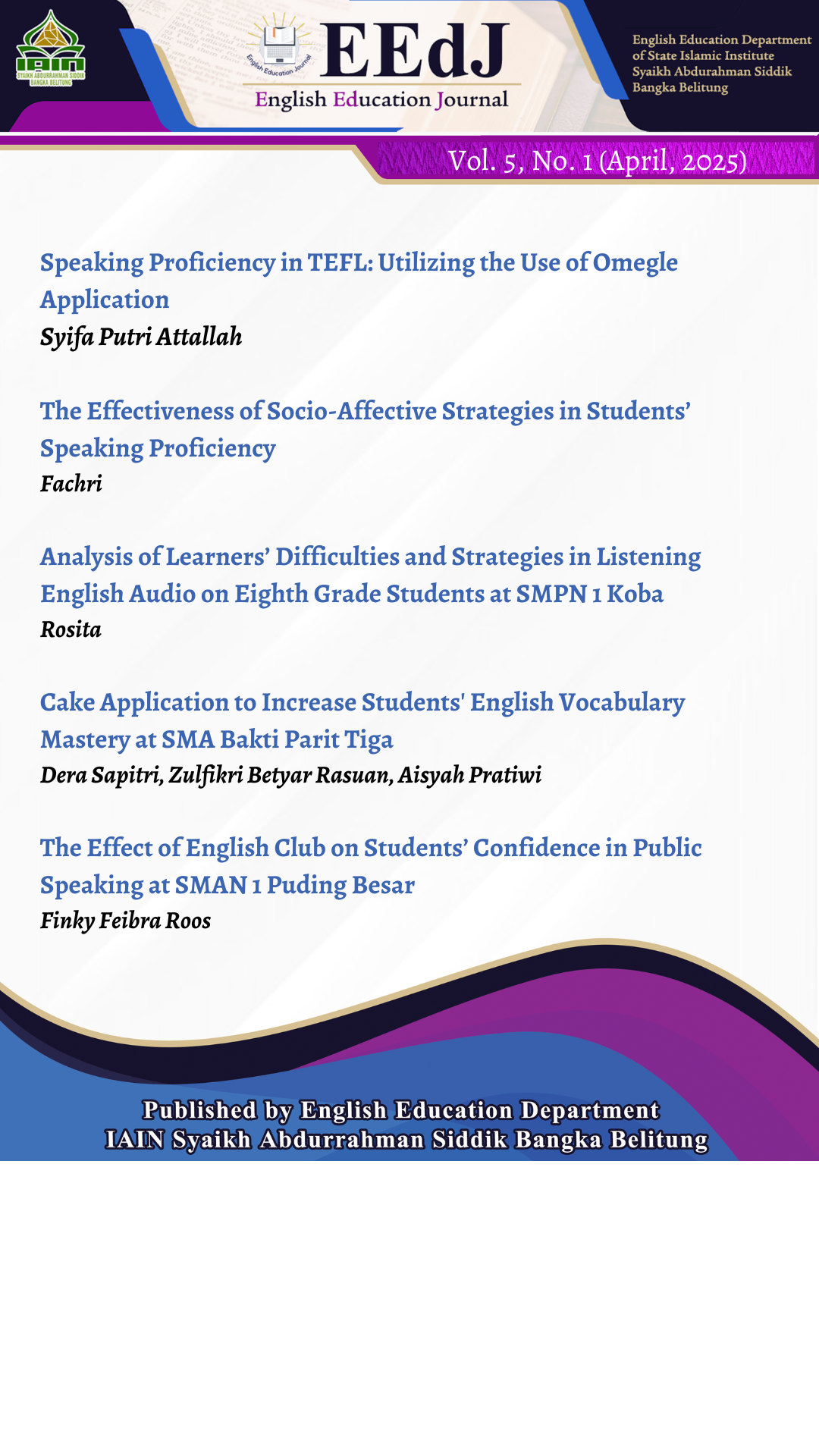
The Effectiveness of Socio-Affective Strategies in Students’ Speaking Proficiency
DOI:
https://doi.org/10.32923/eedj.v5i1.4923Keywords:
Socio affective strategies, Speaking skills, Students’ speaking proficiencyAbstract
This research had the purpose to measure the effectiveness of Socio-affective strategies to enhance students’ speaking proficiency. The method of quantitative was employed with pre-experimental approach. The experiment itself was held in the even semester of 2023/2024 academic year by involving 16 students of grade 9 of SMP Assa’adah, Radio Dalam, South Jakarta. These students were occupied in one class and selected through cluster random sampling. In collecting the data, speaking pre-test and post-test were used as the instruments. The data were analyzed statistically by using Wilcoxon test. The quantitative computation showed that the students performed better in speaking in the post-test in which they gained higher average score, that was 79.37 while in the pre-test the average score reached was only 46.87. Besides, the results of Wilcoxon test revealed that the value of Asymp. Sig. (2-tailed) of 0.001 was lower than 0.05 (0.001 < 0.05). Based on these findings, this research work concluded that Socio affective strategies were effective to enhance students’ speaking proficiency.
Downloads
Published
Issue
Section
License
Copyright Notice
EEdJ: English Education Journal is under the Creative Commons Attribution 4.0 International (CC-BY 4.0) License, according to which:
1) Authors retain copyright and grant the journal the right to first publication, with the work simultaneously licensed under the Creative Commons Attribution (CC-BY 4.0) that allows the sharing of articles published with the acknowledgment of authorship and the initial publication in this journal.
2) The authors are authorized to make additional contracts separately for distribution of the version of the work published in this journal (for example, publication in an institutional repository or as a chapter of the book), as long as there is recognition of authorship and initial publication in this journal.
3) Authors are authorized and encouraged to publish and distribute their work online (for example, in institutional repositories or on their personal pages) at any time before or during the editorial process, as it increases the impact and reference of the published work.