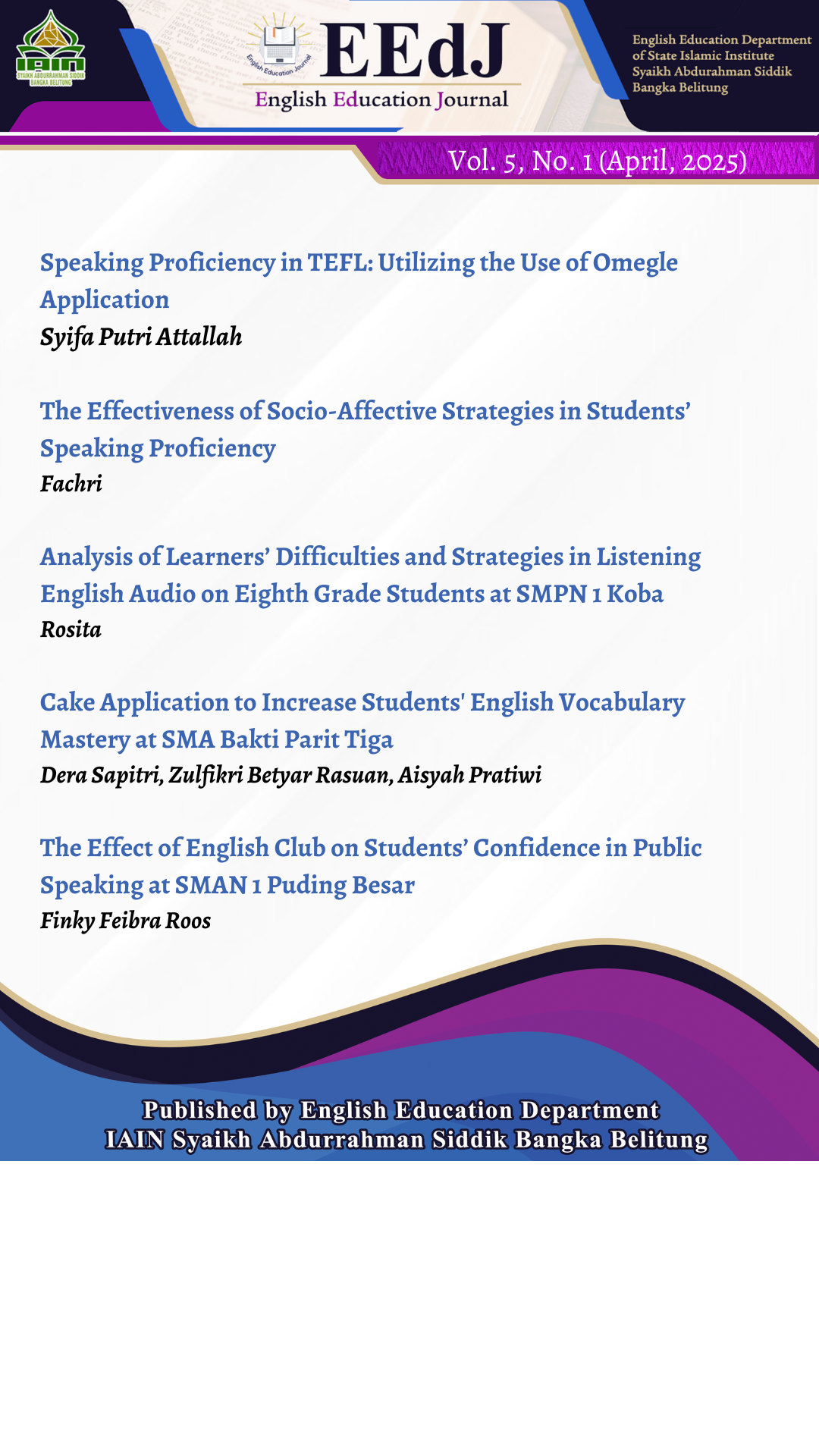
Analysis of Learners’ Difficulties and Strategies in Listening English Audio on Eighth Grade Students at SMPN 1 Koba
DOI:
https://doi.org/10.32923/vm611z67Keywords:
ListeningAbstract
This study aims are to find out listening difficulties most faced by students in listening English and listening strategies most used by students in listening English at eighth grade of SMPN 1 Koba in academic year 2023/2024. The samples of this study were students of class VIII, totaling 185 students. Researcher used descriptive quantitative methods to find students’ difficulties and strategies by giving questionnaire and interview. There are 2 questionnaires used in this research: listening difficulties and listening strategy questionnaire. Also, the researcher interviewed 5 students for support the questionnaire data. The findings of this research showed that the most difficulties faced by students was environment (84%) The next difficulty most faced by students was bad recording (80%) and the last problem most faced by students was anxiety (79%), Meanwhile based on this research the most listening strategy used by students was cognitive (78%) and socio affective (78%), And the last metacognitive strategy (68%). From the conclusion above, teachers are recommended to introduce unfamiliar words as a warm-up before practice, allow students to listen to the audio multiple times, choose audio with topics that match the students' level and interests, and ensure the classroom is quiet during listening activities.
Downloads
Published
Issue
Section
License
Copyright Notice
EEdJ: English Education Journal is under the Creative Commons Attribution 4.0 International (CC-BY 4.0) License, according to which:
1) Authors retain copyright and grant the journal the right to first publication, with the work simultaneously licensed under the Creative Commons Attribution (CC-BY 4.0) that allows the sharing of articles published with the acknowledgment of authorship and the initial publication in this journal.
2) The authors are authorized to make additional contracts separately for distribution of the version of the work published in this journal (for example, publication in an institutional repository or as a chapter of the book), as long as there is recognition of authorship and initial publication in this journal.
3) Authors are authorized and encouraged to publish and distribute their work online (for example, in institutional repositories or on their personal pages) at any time before or during the editorial process, as it increases the impact and reference of the published work.