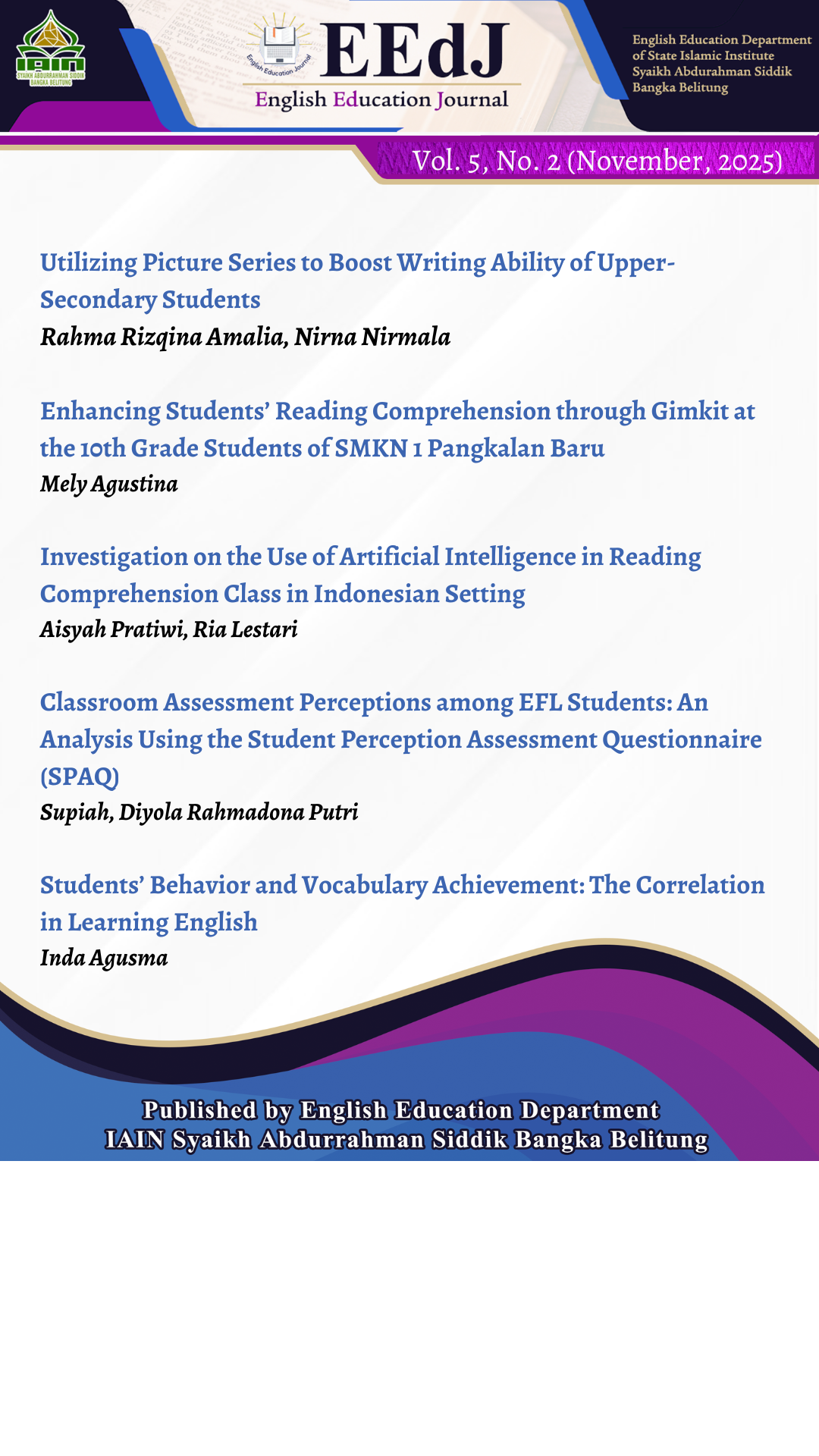
Students’ Behavior and Vocabulary Achievement: The Correlation in Learning English
DOI:
https://doi.org/10.32923/xx0gwf51Keywords:
Students' behavior, Vocabulary achievement, Learning EnglishAbstract
This study aims to find out the students’ behavior in learning discipline towards vocabulary achievement and the correlation of these in eleventh grade students at SMA Negeri 1 Kelapa. The research method used is quantitative with correlational design. The data were collected from questionnaire on students’ behavior and test of vocabulary. The data collection technique was carried out using questionnaire on students’ behavior towards learning which was already validity at school. A total of 20 statement items were declared valid and declared reliable, because the results of rcount > rtable were 0,749 > 0,361. The test using vocabulary test of eleventh grade in students in Vocabulary achievement. The total of 24 questions of vocabulary test items were declared valid and reliable the result was 0,805 > 0,361.The data were analyzed using Pearson’s Product-Moment Correlation. The results showed that rxy (0.477) was higher that table at 5% significant level (0.320) which considered that the alternative hypothesis (Ha) is accepted and the null hypothesis (Ho) is rejected. There was a significant correlation between students’ behavior and students’ English achievement. The students’ behavior and vocabulary achievement showed positive correlation with the majority of level grade showed a strong correlation category.
References
Arikunto, Suharsimi, Prosedur Penelitian Suatu Pendekatan Praktik, Jakarta: PT. Rineka Cipta, 2006.
Dari, Sri Wulan, ‘Distorsi Akhlak Dan Prestasi Belajar Peserta Didik Di MA Darussyari’ah’ (UIN Ar- Raniry Banda Banda Aceh, 2019)
Douglas, D A N, and Stefan Frazier, ‘Teaching by Principles: An Interactive Approach to Language Pedagogy .: H. Douglas Brown’ (Wiley Online Library, 2001)
FIP-UPI, Tim Pengembang Ilmu Pendidikan, ‘Ilmu Dan Aplikasi Pendidikan Bagian III: Pendidikan Disiplin Ilmu’, Bandung: Penerbit Imtima, 2007
Fauzan, Fauzan, Hasan Maksum, Wawan Purwanto, and Eko Indrawan, ‘Hubungan Sikap Belajar Dan Kebiasaan Belajar Dengan Hasil Belajar Mata Pelajaran Teknologi Dasar Otomotif (TDO)’, Mimbar Ilmu, 26.1 (2021), 45–51
Firdaus, Arizal, ‘Pengaruh Lingkungan Sekolah Dan Disiplin Siswa Terhadap Hasil Belajar Siswa Pada Mata Pelajaran Sejarah Kelas XI IPS SMA Islam Almaarif Singosari’ (Universitas Islam Negeri Maulana Malik Ibrahim, 2017)
Fraenkel, Jack R, Norman E Wallen, and Helen H Hyun, How to Design and Evaluate Research in Education
(McGraw-hill New York, 2012), VII
Hasanuddin, Sultan, ‘Hubungan Disiplin Belajar Dengan Hasil Belajar Siswa Pada Mata Pelajaran Pendidikan Agama Islam Di SMPN 2 Ponre Kabupaten Bone’, Al-Iltizam: Jurnal Pendidikan Agama Islam, 1.1 (2016), 13–30
Haryaka, Usfandi, and Haslidia Haslidia, ‘Pengaruh Konsep Diri, Minat Dan Sikap Ilmiah Siswa Terhadap Hasil Belajar Matematika’, in PRISMA, Prosiding Seminar Nasional Matematika, 2019, ii, 737–47
Kusumastuti, Zulaikhah Rita, and Hendra Dedi Kriswanto, ‘The Relationship between Discipline with Student Learning Outcomes of Equality Education Program’, Edukasi, 16.2 (2022), 100–110
McCarthy, Michael, English Vocabulary: The Basics (Taylor & Francis, 2022)
Nurkholis, Nurkholis, ‘Pendidikan Dalam Upaya Memajukan Teknologi’, Jurnal Kependidikan, 1.1 (2013), 24–44
Putra, Hilmi Mubarok, ‘Perilaku Kedisiplinan Siswa Dilihat Dari Etika Belajar Di Dalam Kelas’, Jurnal Prakarsa Paedagogia, 3.1 (2020)
Rahmantori, Arief, ‘Hubungan Antara Kontrol Diri Dan Prokrastinasi Akademik Pada Mahasiswa’, 2018 Sulistiyo, Urip, ‘Improving English as a Foreign Language Teacher Education in Indonesia: The Case of
Jambi University’ (RMIT University, 2015)
Syah, Muhibbin, ‘Psikologi Pendidikan Dengan Pendekatan Baru’, 2001.
Downloads
Published
Issue
Section
License
Copyright (c) 2025 Inda Agusma (Author)

This work is licensed under a Creative Commons Attribution 4.0 International License.
Copyright Notice
EEdJ: English Education Journal is under the Creative Commons Attribution 4.0 International (CC-BY 4.0) License, according to which:
1) Authors retain copyright and grant the journal the right to first publication, with the work simultaneously licensed under the Creative Commons Attribution (CC-BY 4.0) that allows the sharing of articles published with the acknowledgment of authorship and the initial publication in this journal.
2) The authors are authorized to make additional contracts separately for distribution of the version of the work published in this journal (for example, publication in an institutional repository or as a chapter of the book), as long as there is recognition of authorship and initial publication in this journal.
3) Authors are authorized and encouraged to publish and distribute their work online (for example, in institutional repositories or on their personal pages) at any time before or during the editorial process, as it increases the impact and reference of the published work.