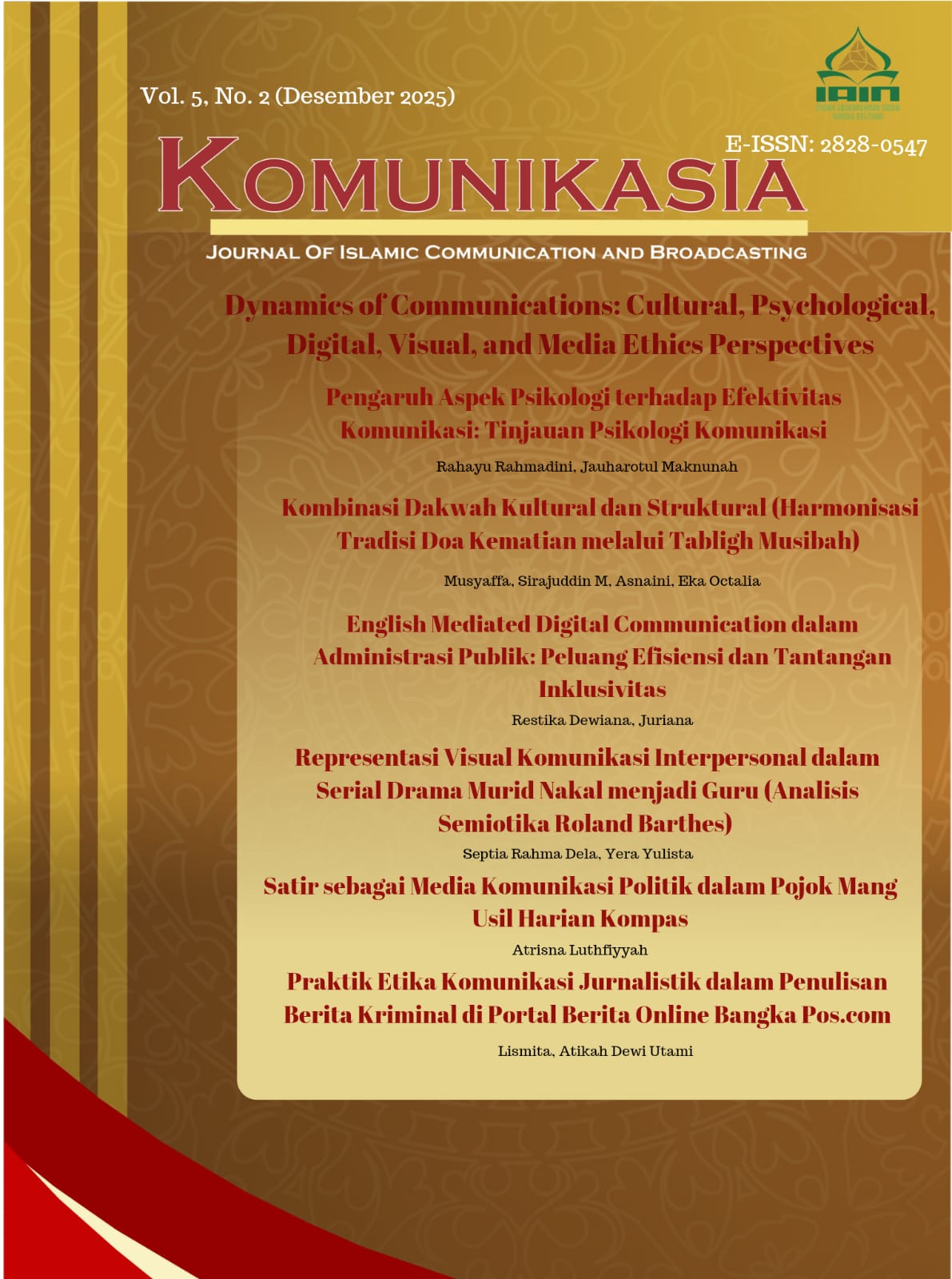
SATIR SEBAGAI BENTUK KOMUNIKASI POLITIK DALAM POJOK MANG USIL HARIAN KOMPAS
DOI:
https://doi.org/10.32923/yxh82m96Keywords:
Satir Politik, Analisis Wacana Kritis, Komunikasi Politik, Pojok Mang Usil, KompasAbstract
Penelitian ini mendeskripsikan bagaimana kritik terhadap isu politik, sosial, dan birokrasi dikonstruksi melalui humor dan sindiran dalam rubrik Pojok Mang Usil Harian Kompas. Melalui pendekatan Analisis Wacana Kritis, penelitian ini menelaah struktur teks, praktik diskursif, dan praktik sosial yang membentuk makna dan ideologi di balik satir tersebut. Objek penelitian mencakup arsip Pojok Mang Usil selama Oktober–November 2025, sebuah periode yang ditandai oleh intensitas pemberitaan politik nasional, dinamika kebijakan pemerintah, serta meningkatnya ketegangan sosial yang menjadi sasaran kritik media. Hasil analisis menunjukkan bahwa Pojok Mang Usil memanfaatkan strategi retoris seperti ironi, metafora, hiperbola, intertekstualitas, dan permainan bahasa untuk membingkai isu-isu publik secara kritis. Rubrik ini berfungsi sebagai mekanisme framing tambahan dalam ekosistem pemberitaan Kompas, serta sebagai bentuk resistensi simbolik terhadap relasi kuasa. Satir dalam rubrik ini juga terbukti mampu menurunkan resistensi pembaca dan membuka ruang refleksi politik. Penelitian ini berkontribusi pada pengayaan literatur mengenai satir politik di media cetak dan membuka peluang bagi penelitian komparatif dengan satir di media digital.
Downloads
Published
Issue
Section
License
Copyright (c) 2025 KOMUNIKASIA: Journal of Islamic Communication and Broadcasting

This work is licensed under a Creative Commons Attribution 4.0 International License.
Copyright Notice
Komunikasia: Journal of Islamic Broadcasting and Communication is under the Creative Commons Attribution 4.0 International (CC-BY 4.0) License, according to which:
1) Authors retain copyright and grant the journal the right to first publication, with the work simultaneously licensed under the Creative Commons Attribution (CC-BY 4.0) that allows the sharing of articles published with the acknowledgment of authorship and the initial publication in this journal.
2) The authors are authorized to make additional contracts separately for distribution of the version of the work published in this journal (for example, publication in an institutional repository or as a chapter of the book), as long as there is recognition of authorship and initial publication in this journal.
3) Authors are authorized and encouraged to publish and distribute their work online (for example, in institutional repositories or on their personal pages) at any time before or during the editorial process, as it increases the impact and reference of the published work.