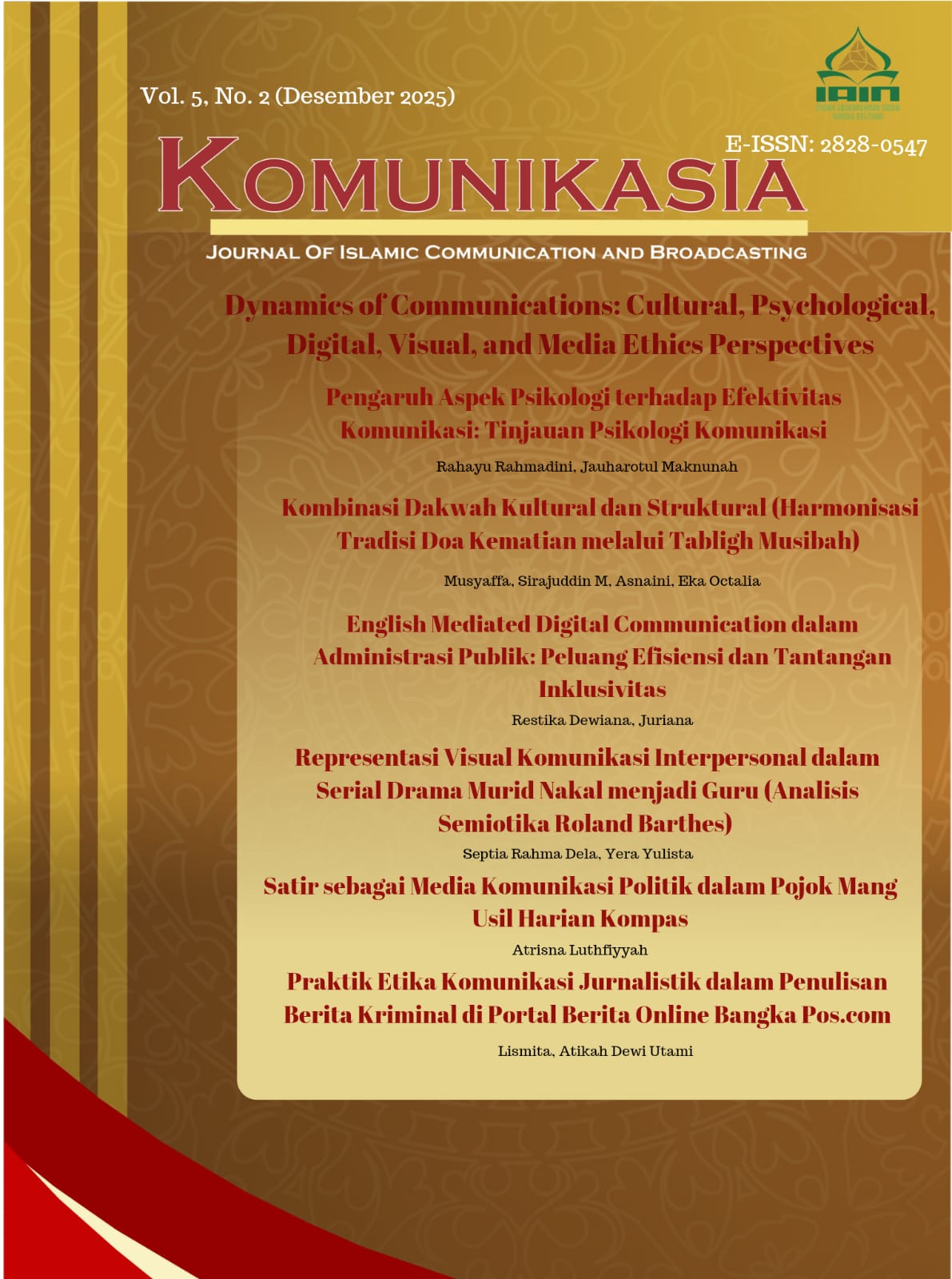
English-Mediated Digital Communication dalam Administrasi Publik
Peluang Efisiensi dan Tantangan Inklusivitas
DOI:
https://doi.org/10.32923/7jvnk510Keywords:
english-mediated digital communication, administrasi publik, literasi digital, inklusi, e-government, literasi, digitalAbstract
English-Mediated Digital Communication (EMDC)—penggunaan bahasa Inggris dalam saluran digital, dokumentasi, standar teknis, API, dan interaksi lintas negara dalam administrasi publik—menjadi semakin penting di era digitalisasi dan globalisasi pemerintahan. Kajian literatur ini menelaah pengaruh EMDC terhadap efisiensi administrasi publik, dengan fokus pada interoperabilitas, transfer pengetahuan, adopsi inovasi, kolaborasi internasional, dan jangkauan layanan kepada warga. Temuan menunjukkan bahwa EMDC meningkatkan integrasi sistem, percepatan layanan digital, dan akses terhadap praktik terbaik global apabila aparatur publik memiliki kemampuan bahasa Inggris dan literasi digital yang memadai. Namun, EMDC juga menghadirkan tantangan, seperti risiko eksklusi bagi pemangku kepentingan dengan kemampuan bahasa terbatas, ketergantungan pada platform berbahasa Inggris, dan kesenjangan dalam konteks multibahasa atau negara berkembang. Kajian ini menekankan pentingnya strategi seimbang, termasuk kebijakan multibahasa, pelatihan literasi digital, dan implementasi inklusif, untuk memaksimalkan manfaat EMDC sekaligus meminimalkan risiko.
References
Alizadeh, Minoo. “Digital Competence and English Proficiency in the Context of Globalized Governance.” Journal of Language and Intercultural Communication 21, no. 4 (2021): 478–495.
Aitamurto, Tanja, and Hélène Landemore. “Crowdsourced Deliberation: The Case of the Law on Off-Road Traffic in Finland.” Policy & Internet 7, no. 2 (2015): 174–196.
Björkman, Beyza. English as a Lingua Franca in the Digital World. Cambridge: Cambridge University Press, 2020.
Blommaert, Jan. The Sociolinguistics of Globalization. Cambridge: Cambridge University Press, 2010.
Cameron, Deborah. Working with Spoken Discourse. London: Sage Publications, 2001.
Castells, Manuel. The Rise of the Network Society. 2nd ed. Oxford: Blackwell Publishing, 2010.
Chadwick, Andrew. The Hybrid Media System: Politics and Power. Oxford: Oxford University Press, 2017.
Chen, Yu-Che. Managing Digital Governance: Design, Strategy, and Practice. New York: Routledge, 2017.
Chen, Yu-Che. “Digital Governance: Building Resilience in Public Administration.” Government Information Quarterly 39, no. 2 (2022): 101681.
Chen, Yu-Che, and Micah Altman. “Digital Democracy and Public Governance: Governance Innovation and the Challenge of Inclusion.” Government Information Quarterly 38, no. 3 (2021): 101568.
Cowan, Chris, and Faiza Khalid. “Digital Literacy, English Proficiency, and Access to Online Knowledge: A Framework for Public Sector Competency.” Information Technology & People 33, no. 6 (2020): 1956–1973.
European Commission. New European Interoperability Framework: Promoting Seamless Services and Data Flows. Brussels: Publications Office of the European Union, 2017.
Fountain, Jane. Building the Virtual State: Information Technology and Institutional Change. Washington, DC: Brookings Institution Press, 2001.
Gil-Garcia, J. Ramon, Theresa A. Pardo, and Luis F. Luna-Reyes. “Digital Government and Artificial Intelligence: Toward Public Sector Data Ecosystems.” Government Information Quarterly 39, no. 4 (2022): 101735.
Jenkins, Jennifer, Will Baker, and Martin Dewey. The Routledge Handbook of English as a Lingua Franca. 2nd ed. London: Routledge, 2018.
Downloads
Published
Issue
Section
License
Copyright (c) 2025 KOMUNIKASIA: Journal of Islamic Communication and Broadcasting

This work is licensed under a Creative Commons Attribution 4.0 International License.
Copyright Notice
Komunikasia: Journal of Islamic Broadcasting and Communication is under the Creative Commons Attribution 4.0 International (CC-BY 4.0) License, according to which:
1) Authors retain copyright and grant the journal the right to first publication, with the work simultaneously licensed under the Creative Commons Attribution (CC-BY 4.0) that allows the sharing of articles published with the acknowledgment of authorship and the initial publication in this journal.
2) The authors are authorized to make additional contracts separately for distribution of the version of the work published in this journal (for example, publication in an institutional repository or as a chapter of the book), as long as there is recognition of authorship and initial publication in this journal.
3) Authors are authorized and encouraged to publish and distribute their work online (for example, in institutional repositories or on their personal pages) at any time before or during the editorial process, as it increases the impact and reference of the published work.